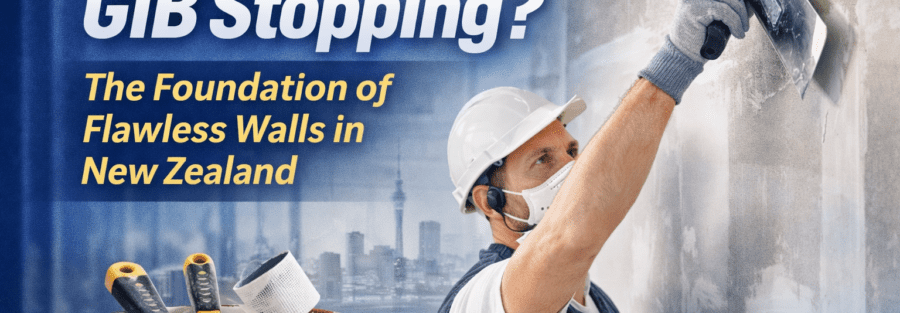
Walk into any modern home or commercial space and you’ll immediately notice the smoothness of the walls. What you don’t see is the technical craftsmanship behind that perfection.
That invisible craftsmanship is called GIB stopping. In New Zealand construction, GIB stopping is not optional — it is the structural finishing process that transforms raw plasterboard into seamless, paint-ready surfaces. Without it, every joint, screw, and corner would remain exposed, weakening both appearance and durability.
Discover what GIB stopping is and why it’s essential for smooth, crack-free walls & ceilings. Auckland’s trusted experts for durable, professional finishes.
The True Definition of GIB Stopping in NZ Construction
GIB stopping is the specialised finishing process applied after plasterboard installation. It involves reinforcing, filling, layering, smoothing, and refining all joints and fixings to create a continuous surface across walls and ceilings.
In simple construction terms:
- GIB lining installs the boards.
- GIB stopping makes the boards disappear.
It ensures that the entire surface behaves as one unified structure instead of separate panels.
Why GIB Stopping Is Critical in Timber-Framed New Zealand Homes
New Zealand properties are primarily built using timber framing. Timber expands and contracts due to temperature and humidity changes.
That natural movement creates stress along plasterboard joints.
Without professional stopping:
- Hairline cracks appear
- Joint lines shadow under lighting
- Corners separate
- Paint reveals imperfections
- Structural stress increases over time
Proper GIB stopping absorbs this movement through reinforcement and layered application. It is not just cosmetic — it is structural surface protection.
The Professional GIB Stopping Process Explained
Many assume stopping is simply “applying filler.” In reality, it is a controlled multi-stage system requiring precision.
Surface Preparation & Inspection
Before compound application begins, professionals inspect:
- Board alignment
- Screw depth
- Joint gaps
- Framing movement risk
Preparation determines final quality.
Joint Taping for Reinforcement
Specialist joint tape is embedded into compound along every join.
This reinforcement prevents future cracking by distributing stress across the seam.
Multi-Layer Compound Application
Stopping compound is applied in multiple coats:
- Base coat to secure tape
- Build coat to widen and level
- Finishing coat to feather edges seamlessly
Each layer must dry fully before the next application.
Corner Structuring & Strengthening
Internal and external corners are shaped and reinforced carefully. Weak corners are one of the first areas to fail if done incorrectly.
Precision Sanding & Surface Refinement
After curing, sanding is performed with controlled pressure to ensure smoothness without thinning reinforcement areas.
Light-Level Inspection
Professionals check surfaces under angled lighting to detect micro-imperfections that standard inspection would miss.
This stage separates average workmanship from premium results.
GIB Stopping Finish Levels and What They Mean
Not all finishes are equal. The level of finish required depends on lighting conditions and paint type.
Level 3 Finish
Basic finish used behind tiles or textured areas.
Level 4 Finish
Standard paint-ready finish suitable for most residential builds.
Level 5 Finish
High-end skim finish applied across the entire surface. Required for:
- Feature lighting
- Gloss or dark paint
- Architectural homes
- Commercial presentation areas
The higher the finish level, the more skilled labour and attention to detail required.
Where GIB Stopping Is Essential
GIB stopping is required in nearly every interior project:
- New residential builds
- Renovations and extensions
- Ceiling replacements
- Office fit-outs
- Apartment developments
- Retail spaces
- Water damage repairs
Wherever plasterboard exists, stopping is mandatory for professional results.
Common Failures Caused by Poor GIB Stopping
When corners are rushed or low-quality materials are used, problems appear quickly.
Typical issues include:
- Bubbling or lifting tape
- Uneven sanding marks
- Visible ridges under LED lighting
- Cracking along joins
- Flaking compound
- Surface depressions
These defects often become noticeable only after painting — when repair costs increase significantly.
How GIB Stopping Directly Impacts Paint Performance
Paint does not hide imperfections. It enhances them.
Modern LED lighting especially exposes:
- Surface waves
- Poor feathering
- Inconsistent sanding
- Joint visibility
High-quality stopping ensures:
- Even paint absorption
- Uniform light reflection
- Long-term crack resistance
- Premium finish appearance
Think of stopping as the engineering beneath the paint layer.

Is GIB Stopping the Same as Plastering?
While related, they are not identical.
GIB stopping focuses specifically on:
- Joint finishing
- Screw hole filling
- Surface levelling of plasterboard
Plastering may include broader applications such as skim coating or exterior rendering.
In most New Zealand homes, GIB stopping forms a core part of the interior plastering system.
Why Professional GIB Stopping Is a Smart Investment
DIY attempts often underestimate the skill involved.
Professional stopping requires:
- Technical understanding of compound behaviour
- Experience with NZ timber movement
- Correct tape embedding technique
- Controlled sanding without surface damage
- Knowledge of finish-level requirements
The difference between amateur and professional stopping becomes obvious under lighting — and even more obvious after 12 months of structural movement.
Investing in experienced professionals prevents recurring repairs and protects long-term property value.
When Should You Choose a Premium Finish?
If your property includes:
- Open-plan living areas
- Large ceiling spans
- Skylights
- Downlights
- Feature walls
- Dark or high-sheen paint
Then premium-level stopping is not optional.
These environments magnify surface flaws instantly.
Final Insight: GIB Stopping Determines Interior Quality
Behind every flawless interior lies precise stopping work.
It determines:
- Surface smoothness
- Crack resistance
- Paint durability
- Visual perfection
When done correctly, it becomes invisible.
And that invisibility is the mark of true craftsmanship.